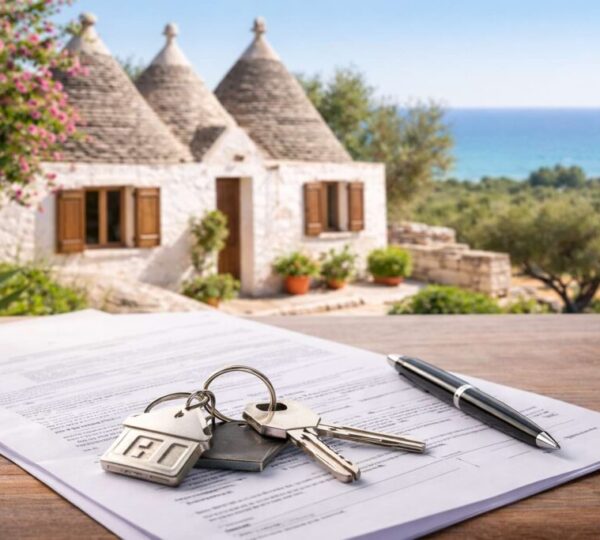
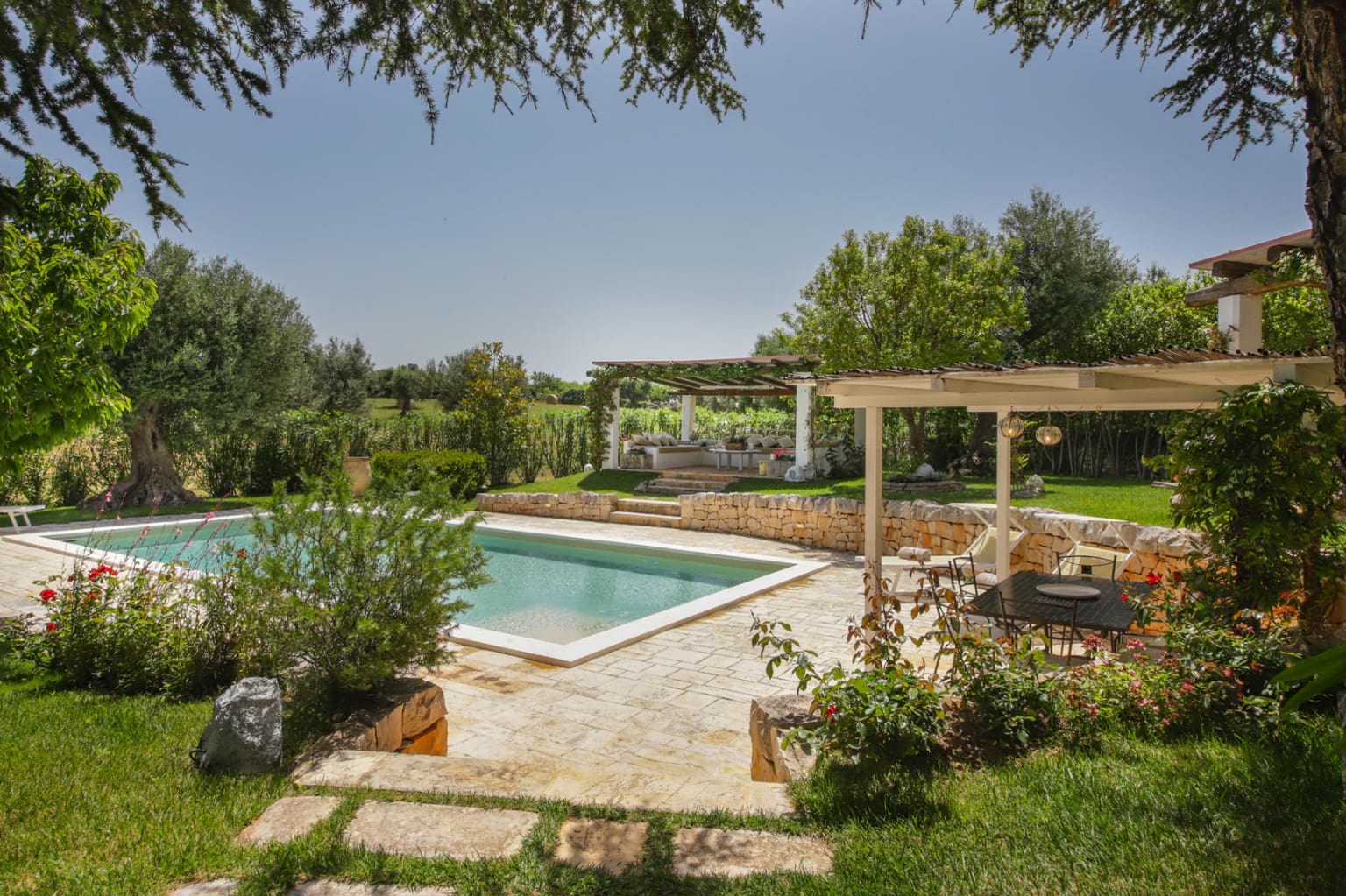
Most people buying in Puglia want two things at once: a house to enjoy for a few weeks a year, and a property that earns its keep for the rest, enough to take care of the tax, the utilities, the upkeep of owning abroad.
Whether it can do that depends on something many buyers overlook until it is too late. Four things are required to let legally: a notification to the council (a SCIA or CIA, depending on how the activity is run), the national CIN code, public liability insurance covering guests, and registration in the regional tourism database. What changed in 2026 is the timing: they need to be considered before you make an offer, not after the purchase is complete.
That shift matters especially if you are buying from abroad: a trullo in the Itria Valley, a masseria outside Ostuni, a townhouse in a historic centre. Puglia has become a mature tourism market: the regional database now records more than 44,000 active properties, which in 2025 accounted for 18.7% of all arrivals in the region, up 27.7% on the previous year. Markets of that size get regulated, and the rules are worth understanding before you commit.
Buying from abroad: what needs planning
Buying in Italy is generally straightforward for foreign buyers. EU and EEA citizens purchase on the same basis as Italian citizens; buyers from outside the EU may need to meet reciprocity requirements or hold a valid Italian residence permit.
Three things are worth arranging early.
A codice fiscale, free and essential to almost every step that follows.
Traceable payment arrangements, since the funds used are declared in the deed itself. And a power of attorney if you would rather not travel to complete. A representative can sign on your behalf, and where you attend in person without Italian, an interpreter and a translation of the deed are required.
The harder part comes after completion: running the property from another country. The registrations and recurring filings involved in letting sit on Italian public-sector portals built around SPID and CIE, the national digital identity systems, which a non-resident owner rarely holds.
There are routes around this: a dedicated accreditation for foreign users, or a written delegation to a professional or manager. Most of our overseas buyers use one of them. It is simply far easier to set up before the first booking than from abroad at the last minute.
What a property needs in order to host guests
A property used for tourist accommodation in Puglia has to be sound on three separate levels:
- Planning and land registry: The building as it stands must match its filed plans and titles, with a valid habitability certificate and a compatible permitted use;
- Administrative: The SCIA or CIA notification, the regional CIR code and the national CIN code;
- Technical: safety equipment and minimum floor areas.
A property can be excellent commercially and still fail on any one of these three. That is the single most useful thing to know before you start viewing.
Private owner or business? The two-apartment threshold
Before buying, it is worth deciding how you intend to run the property, because tax treatment and obligations follow from it.
Most overseas buyers letting through online platforms fall under tourist letting (locazione turistica). This covers renting out the property with basic services only: cleaning, linen, Wi-Fi.
Offering structured services on top of that puts you in a different category. A B&B, guest rooms or a residence counts as extra-hotel accommodation under regional law 11/1999, where the requirements are more demanding.
Within tourist letting, the dividing line is broadly numerical:
- Up to two apartments: the activity is generally treated as non-business. The number alone is not decisive. If the operation is professionally organised with structured services, business classification remains possible.
- More than two apartments in the same tax year: the law presumes the activity is being run as a business, with the obligations that follow, starting with an Italian VAT number.
If you are planning a small portfolio rather than a single home, factor that threshold in from the first purchase.
SCIA or CIA: notifying the council
Every property used for tourist letting must be notified to the SUAP (the one-stop business desk of the comune where the property sits).
- Owners letting on a non-business basis file a CIA (Comunicazione di Inizio Attività, a notice of commencement).
- Those operating as a business file a SCIA (Segnalazione Certificata di Inizio Attività, a certified notification).
A deadline that matters if you are buying an existing rental. Regional law 15/2025 set 30 September 2026 as the final date by which tourist lets already operating must regularise their position by filing the CIA or SCIA. Many properties currently on the market have a CIN and live listings but have never filed anything with their council. If you are buying a going concern, establish during negotiations whether the seller has completed this step; if not, the exposure becomes yours.
CIR, CIN and the regional register
Two codes are needed to advertise legally, obtained in a fixed order:
- Register the property in the regional database at dms.puglia.it, which issues the CIR, the regional identification code.
- Within thirty days of receiving the CIR, apply for the CIN, the national identification code, through the Ministry of Tourism’s national accommodation database.
The CIN is compulsory for every property, including a single apartment let by a private owner. It must be displayed on the exterior of the building and included in every listing, wherever published. That is precisely what makes compliance so easy to verify from a desk.
Alongside these sit the recurring obligations: submitting occupancy data to the regional tourism agency through the SPOT Easy system, reporting guests to the national police portal AlloggiatiWeb within the required timeframe, and collecting and remitting tourist tax where the local council levies it. A management partner will normally handle all three on your behalf.
Insurance and safety requirements
Whichever way the property is run, two requirements apply to anyone accommodating guests:
- Public liability insurance covering guests, proportionate to the property’s capacity in beds.
- Safety equipment: working gas and carbon monoxide detectors, and compliant portable fire extinguishers, at least one per floor and one per 200 m² of floor area.
Neither is expensive in the context of a purchase, but both belong in the budget from the outset, together with a check on the certification of the existing electrical and gas installations. In older stone buildings that certification is often the item that turns out to be missing.
Floor areas and bed count: what the property can actually sleep
This is one of the points most often overlooked at purchase, yet it directly affects your potential return on investment.
The usable floor area and layout of a property determine by law how many beds it can licensedly accommodate, setting the maximum revenue it can generate in peak season.
While regional regulations set baseline square metre requirements for standard residential rooms, these rules do not apply uniformly across all property types.
Puglia’s historic and traditional architecture, most notably trulli, lamie, and masserie, benefits from specific legal exemptions and municipal derogations. Given their unique structural features, such as thick stone walls, alcoves, and conical roofs, historic properties are frequently permitted to host guests with floor areas below the standard thresholds required for modern buildings.
In investment terms, two properties at the same price in the same location can have entirely different licensed bed capacities and financial returns. Reviewing the floor plan with a local specialist before making an offer is the only way to establish the property’s true operational potential.
The 2026 draft law on municipal caps
On 19 May 2026 the regional government approved a draft law allowing councils in high-density tourism areas and provincial capitals to designate specific zones where new tourist lets can be regulated, including numerical caps. The bill has passed to the Regional Council for final approval and applies only to new openings: the text provides transitional protection for activities already operating and properly registered.
Because the measure is expected to protect existing compliant operations, regularising a property’s position now is what places an investment inside that transitional protection rather than outside it.
Owning from abroad: who runs the property when you are not there
For most overseas buyers this is the real question behind all the others. Compliance is manageable; the practical issue is that the property sits in Puglia and you do not.
Trulli & Dimore Real Estate works with specialist management partners who handle exactly this arrangement. You tell them the dates you want the house for yourself; for the remaining days they take on the letting: promotion and listings, guest communication and check-in, cleaning between stays, routine maintenance and the seasonal upkeep that stone buildings and olive groves genuinely need. It is a model built around owners who use the property several weeks a year and want it working, and looked after, for the rest.
It also resolves the day-to-day compliance load quietly: guest reporting, occupancy data, tourist tax collection. These are obligations with short deadlines that are difficult to meet reliably from another country.
Your checklist before buying
Before signing an offer or preliminary contract, make sure the following have been verified:
- Planning and land registry conformity: the building as it stands matches the filed plans and permits
- Habitability certificate and permitted use: present, and compatible with tourist accommodation
- Current municipal regulations: any restrictions already in force in that area
- Usable floor areas: the bed count actually licensable under the regional parameters
- Installations: existing certification, gas and CO detectors, extinguishers
- Landscape and heritage restrictions: particularly relevant for trulli, lamie and masserie
- Position at the SUAP: the property’s administrative status, if already used for letting
- Codice fiscale, banking and power of attorney: arranged early if you are buying from abroad
A calm negotiation starts before the signature, and it starts with the details.
Trulli & Dimore Real Estate provides buyers and sellers with a dedicated lawyer specialising in property law. Stefania Lisi, Attorney at Law, coordinates preliminary due diligence together with our trusted surveyors, reviewing plans, titles and administrative requirements before offers are made. This allows sellers to present a property at its best and buyers to commit with certainty on both risk and timing.
For overseas purchases, that support extends to all practical and legal steps: verifying reciprocity, arranging power of attorney, handling language requirements at the deed, obtaining your codice fiscale, and setting up the necessary delegations for short-term rental registrations once the property is yours.
Thinking about investing in Puglia? Talk to our legal team.